
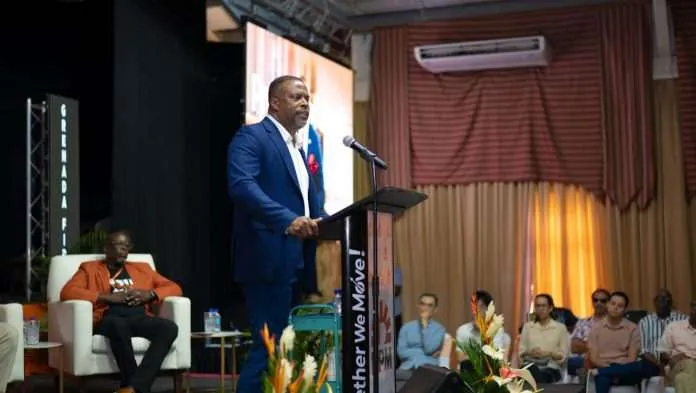
 Premier of Nevis, Mark Brantley, has called on Caribbean nations to take greater control of their future, warning that shifting global dynamics demand urgent regional action and self-reliance.
Brantley delivered the keynote address at the inaugural congress of Grenada’s Democratic People’s Movement (DPM), held in Morne Rouge on March 22, where he emphasised that “the Caribbean must save itself” in an increasingly unstable and unpredictable world.
Addressing the party members and supporters, Brantley praised DPM leader Peter David and his team for what he described as a “bold step” in service to the people of Grenada, Carriacou and Petite Martinique.
While noting his longstanding personal ties to Grenada through his wife, Brantley made it clear that his remarks were rooted in concern for the wider region, as geopolitical tensions continue to escalate globally.
He pointed to recent international conflicts and economic disruptions as evidence that small island states are especially vulnerable to external shocks. Rising fuel costs, increased shipping expenses, and higher living costs, he warned, would disproportionately impact ordinary Caribbean citizens.
“The single mother, the elderly, and those already struggling will feel it most,” Brantley said, adding that Caribbean households would be forced to bear burdens created beyond their control.
Brantley also highlighted concerns about the apparent erosion of the rules-based international order, referencing statements from global leaders suggesting that power and military strength are increasingly replacing established norms.
He warned that such a shift could marginalise small developing states like those in the Caribbean, which have historically relied on multilateral systems to have their voices heard on issues such as climate change.
“If the rules are dismantled, what happens to the Caribbean?” he questioned.
In response, Brantley advocated for deeper regional integration and stronger collaboration among Caribbean nations, urging leaders to accelerate efforts toward a single economic space and more unified foreign policy positions.
He also addressed tightening immigration policies in traditional partner countries, suggesting that these developments should be seen as an opportunity rather than a setback.
According to Brantley, Caribbean governments should actively encourage members of the diaspora to return home, bringing their skills, capital, and innovation to help drive regional development.
“We must transform brain drain into brain gain,” he said.
The Nevis Premier further stressed the need for economic diversification, warning against over-reliance on citizenship-by-investment (CBI) programmes. He cited data indicating that such programmes account for a significant portion of government revenues in several Organisation of Eastern Caribbean States (OECS) countries.
To strengthen economic resilience, Brantley proposed a series of measures, including expanding renewable energy, improving food security, increasing returns from the cruise industry, investing in the creative economy, and developing special economic zones.
He also called for policies to stimulate local entrepreneurship, attract diaspora investment, and grow national populations to support sustainable economic expansion.
Throughout his address, Brantley maintained that regional unity and proactive policymaking would be essential in navigating what he described as a new global reality.
“There is no one coming to save Grenada. There is no one coming to save the Caribbean,” he declared. “We must save ourselves.”
He concluded by encouraging members of the Democratic People’s Movement to remain steadfast in public service, despite challenges, and to prioritise the needs of the people above all else.